Where to Buy IGF-1 LR3 Without a Prescription in 2026
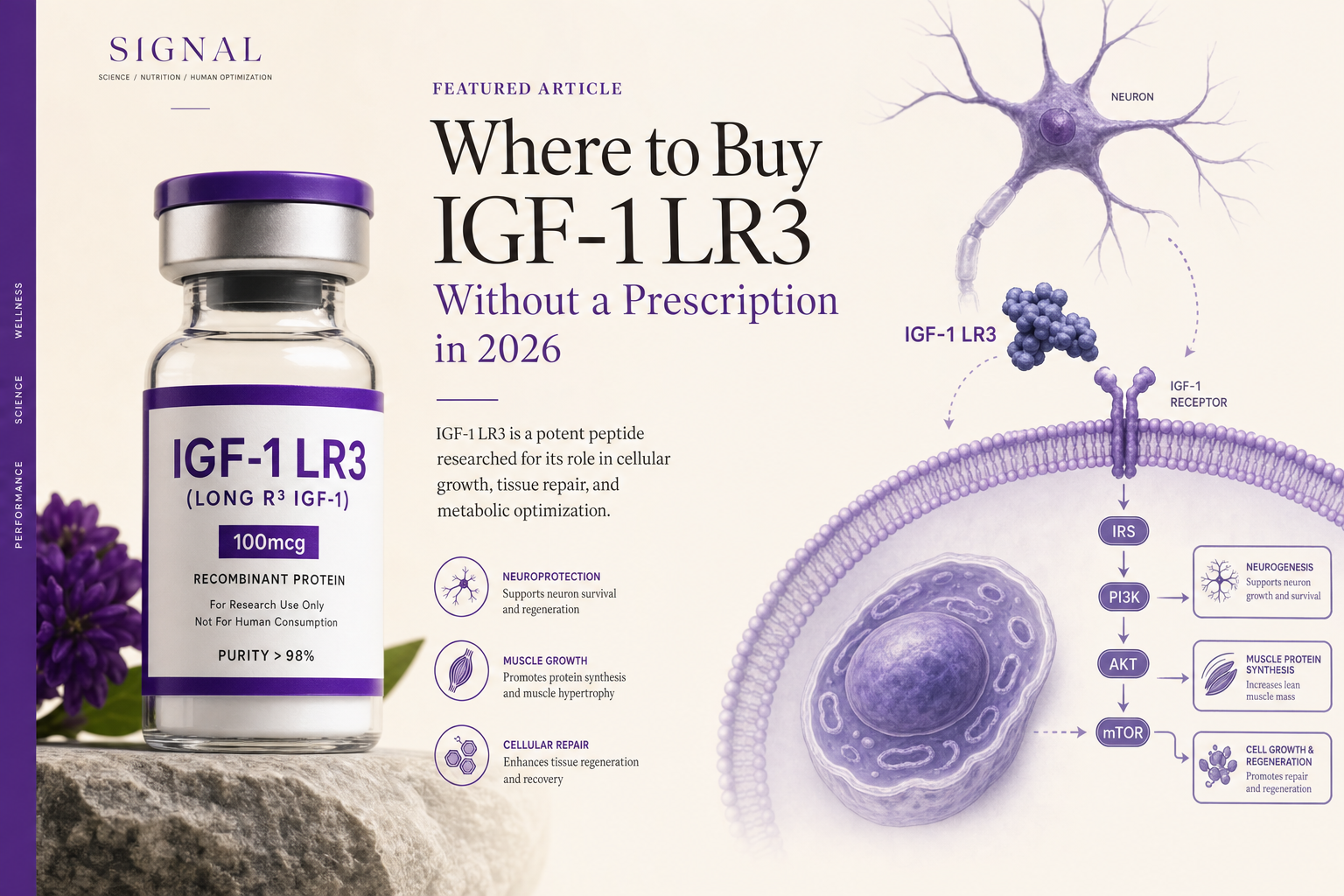
Q: Where can I buy IGF-1 LR3 without a prescription in 2026?
A: You technically can’t — any source selling IGF-1 LR3 without a prescription is operating in the gray market as a “research chemical” vendor, with no purity verification, dosing guidance, or legal protection. The recommended path is a licensed telehealth clinic such as SeinfeldMD.com, where a physician evaluates your case and, if appropriate, prescribes pharmaceutical-grade 503A compounded IGF-1 LR3. This route is faster, safer, and often cheaper than buyers assume.
If you’ve typed where to buy IGF-1 LR3 without a prescription into a search bar, you’re not alone — and you’re also not in the wrong place to course-correct. That single query, more than almost any other peptide search, exposes the buyer to counterfeit product, sterility failures, and outright legal risk. IGF-1 LR3 is not a supplement. It’s a potent insulin-like growth factor analog that, when used without medical oversight, can shift glucose metabolism, drive unintended tissue growth, and interact poorly with underlying conditions a layperson hasn’t screened for.
This guide walks through what IGF-1 LR3 actually is, the three real ways people obtain it in 2026, and why the licensed telehealth route — doctor-prescribed, 503A compounded, pharmaceutical-grade — has quietly become the most cost-effective option, not the most expensive.
What Is IGF-1 LR3?
IGF-1 LR3 (Long R3 Insulin-like Growth Factor-1) is a modified analog of endogenous IGF-1, the primary mediator of growth hormone’s downstream effects on tissue. The “LR3” modification — an arginine substitution and a 13-amino-acid N-terminal extension — dramatically reduces its binding to IGF-binding proteins, which extends its half-life from minutes (native IGF-1) to roughly 20–30 hours. This pharmacokinetic profile is why it’s studied in contexts of muscle protein synthesis, cellular recovery signaling, and metabolic regulation.
Because IGF-1 LR3 is biologically active and influences pathways tied to glucose handling, insulin sensitivity, and cell proliferation, it is appropriately handled as a prescription compound under physician supervision. It is not classified, sold, or regulated as a dietary supplement in the United States. Any vendor implying otherwise is misrepresenting the product.
Where to Buy IGF-1 LR3 in 2026: Your 3 Options
There are essentially three pathways a person encounters when sourcing IGF-1 LR3. They differ enormously in safety, legality, and clinical outcome.
Option 1: Research-Use-Only Suppliers (Highest Risk)
This is what most no-prescription searches lead to: websites selling vials of IGF-1 LR3 stamped with disclaimers like “for research purposes only — not for human consumption.” That label isn’t a marketing quirk; it’s a legal shield that lets the vendor avoid FDA drug regulations.
- No clinical oversight. No physician reviews your labs, conditions, or medications.
- Unverified purity and identity. Independent testing has repeatedly found research-chemical peptides under-dosed, contaminated with bacterial endotoxins, or containing the wrong peptide entirely.
- No dosing guidance. You’re left to source protocols from forums — a notoriously unreliable practice for a compound that affects insulin signaling.
- Legal gray zone. Importation, possession, and self-administration of unapproved drug substances exposes the buyer to customs seizure and, in some states, controlled-substance scrutiny.
The phrase “research chemicals” exists because these products are not — and legally cannot be — sold for human use. Choosing this route is choosing to be your own pharmacist, chemist, and physician simultaneously.
Option 2: DIY / Compounded From Raw Powder (Moderate Risk)
A subset of buyers attempt to mitigate Option 1’s pitfalls by purchasing lyophilized peptide powder and reconstituting it themselves with bacteriostatic water. This adds a layer of perceived control but introduces new failure points.
- Sterility risk. Reconstitution outside a sterile compounding environment can introduce bacterial contaminants — particularly hazardous for any injectable.
- Dosing math errors. Calculating concentration, draw volume, and injection units is non-trivial; small mistakes can produce 5–10x dosing errors.
- Still no medical guidance. The underlying source is typically the same gray-market supplier — DIY reconstitution doesn’t change the upstream purity problem.
- Storage and stability. IGF-1 LR3 is fragile; improper handling degrades the peptide silently, so users can’t tell if they’re injecting active compound or denatured protein.
Considering IGF-1 LR3? This is a physician-prescribed treatment — a short consultation determines if it’s right for your protocol. A SeinfeldMD clinician can review your goals, screen for contraindications, and, if clinically appropriate, prescribe pharmaceutical-grade 503A compounded IGF-1 LR3.
Option 3: Telehealth / Doctor-Prescribed (Recommended)
The third option is what most buyers don’t realize exists at the price point they assume: a licensed telehealth clinic that connects patients with a physician, evaluates whether IGF-1 LR3 is clinically appropriate, and — when prescribed — fulfills the order through a 503A compounding pharmacy.
- Physician evaluation. A licensed clinician reviews your history, medications, and goals before any prescription is written.
- Pharmaceutical-grade compounding. 503A compounding pharmacies operate under state board of pharmacy oversight, with verified active ingredient identity, potency, and sterility testing.
- Defined dosing protocol. The prescriber specifies dose, frequency, duration, and monitoring — not a forum thread.
- Legal clarity. A patient-specific prescription dispensed by a licensed pharmacy is the regulated, legal pathway.
SeinfeldMD.com is a telehealth clinic operating in this lane: physician-supervised peptide therapy via 503A compounded prescriptions. The intake-to-prescription timeline is typically days, not weeks, and the cost difference vs. high-end research-chemical vendors is often minimal once you factor in the absence of failed batches, dosing errors, and self-purchased syringes and supplies.
Comparing the Three Pathways
| Factor | Research-Chemical Vendor | DIY From Raw Powder | Telehealth (Doctor-Prescribed) |
|---|---|---|---|
| Physician oversight | None | None | Yes |
| Verified purity | No | No | Yes (503A pharmacy) |
| Sterility assurance | Variable / unverified | User-dependent | USP <797> standards |
| Dosing protocol | Self-determined | Self-determined | Prescribed |
| Legal status | Gray market | Gray market | Lawful Rx |
| Recourse if wrong product | None | None | Pharmacy + clinic |
How to Verify a Trusted Provider
Not every site marketing “telehealth peptides” is operating cleanly. Use this checklist before sharing your medical history or payment information:
- Licensed prescribers. The clinic should clearly identify that prescriptions are written by U.S.-licensed physicians or NPs operating within their state of licensure.
- 503A compounding pharmacy partner. Compounded peptides should be dispensed by a state-licensed 503A pharmacy — not shipped from an overseas source or labeled “research use.”
- Required intake. Legitimate clinics require a medical intake, often labs, and may decline to prescribe. A site that sells without any evaluation is not a clinic.
- Patient-specific prescription. Your name should appear on the prescription label and pharmacy paperwork.
- Transparent compliance language. Look for clear references to physician supervision, compounding regulations, and a published consultation pathway.
- No “not for human consumption” disclaimers. That language is a tell — it indicates research-chemical sourcing regardless of how clinical the website looks.
Pricing & What to Expect
The most persistent myth driving people toward gray-market IGF-1 LR3 is that prescription pathways are dramatically more expensive. In 2026, that’s largely outdated. Telehealth consultation fees for peptide evaluation typically fall in a modest, one-time or membership-style range, and 503A compounded IGF-1 LR3 pricing is generally competitive with — and sometimes lower than — premium research-chemical vendors, especially once you account for what gray-market pricing doesn’t include: clinician guidance, sterility, accurate concentration, supplies, and recourse.
What to expect on the telehealth path:
- Online intake form covering medical history, medications, and goals.
- Lab review — recent labs may be requested, particularly fasting glucose, HbA1c, IGF-1, and a basic metabolic panel.
- Clinician consultation via secure video or asynchronous review.
- Prescription decision. If IGF-1 LR3 is clinically appropriate, a prescription is sent to a partner 503A pharmacy.
- Discreet shipment of the compounded vial with patient-specific labeling and dosing instructions.
- Follow-up for monitoring, dose adjustment, or protocol changes.
Ready to discuss whether IGF-1 LR3 fits your goals? Speak with a clinician who can evaluate your individual case and prescribe accordingly. The intake takes minutes, and you’ll get a clear answer on whether physician-supervised IGF-1 LR3 therapy is appropriate for you.
This article is wellness education, not medical advice. Always consult your physician before starting any peptide therapy or new prescription protocol.
Frequently Asked Questions
Is IGF-1 LR3 legal to buy in the United States?
IGF-1 LR3 is legal to obtain when prescribed by a licensed physician and dispensed by a 503A compounding pharmacy. It is not legal to sell or import for human use without a prescription, which is why no-prescription vendors label it “research use only.”
Can I get IGF-1 LR3 without a prescription?
Not through any legitimate pathway. Sites offering IGF-1 LR3 with no prescription are research-chemical vendors operating outside FDA regulation, with no verification of purity, sterility, or identity. The lawful route is a telehealth or in-person physician evaluation.
How is telehealth IGF-1 LR3 different from research-chemical IGF-1 LR3?
Telehealth IGF-1 LR3 is doctor-prescribed, pharmaceutical-grade, and compounded by a state-licensed 503A pharmacy with verified potency and sterility. Research-chemical IGF-1 LR3 has no clinical oversight, no purity guarantee, and is not legally sold for human use.
How long does the telehealth consultation process take?
At most clinics, including SeinfeldMD, the intake-to-prescription timeline is typically a few days, depending on lab availability and clinician review. Patients often receive their compounded prescription faster than international gray-market shipments arrive.
Is doctor-prescribed IGF-1 LR3 more expensive than research-chemical sources?
Often, no. Once you factor in clinician oversight, verified purity, sterile compounding, supplies, and recourse if something is wrong, telehealth pricing is generally competitive with premium research-chemical vendors — and avoids the hidden cost of failed or counterfeit batches.
Who should not use IGF-1 LR3?
IGF-1 LR3 is not appropriate for everyone. Individuals with active or prior malignancy, certain endocrine conditions, uncontrolled diabetes, or specific medication regimens may be poor candidates. This is precisely why a physician evaluation — rather than self-sourcing — is the appropriate first step.