Where to Buy BPC-157 Capsules in 2026: Safe Sources
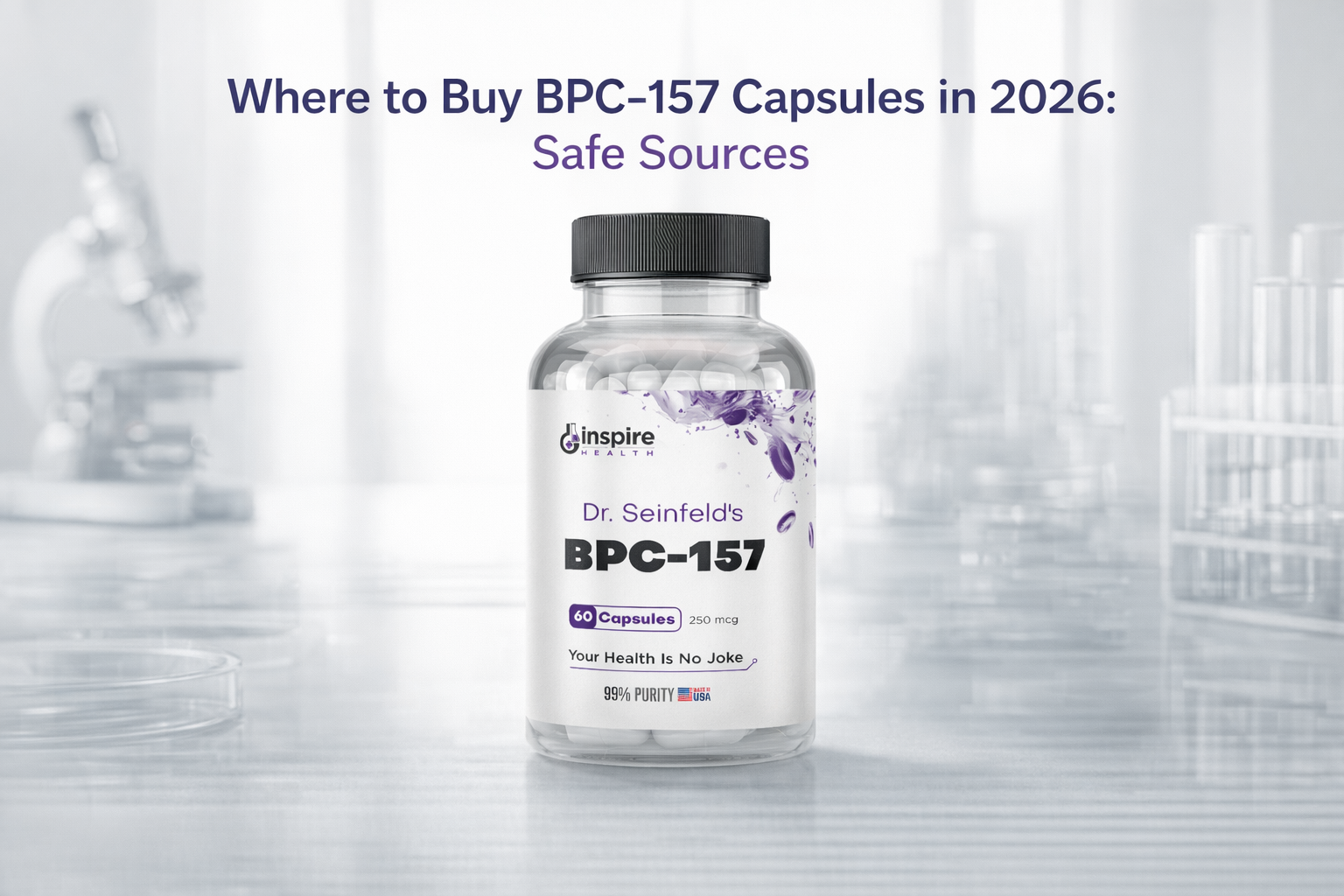
Q: Where can I buy BPC-157 capsules legally and safely in 2026?
A: The safest way to obtain BPC-157 capsules in 2026 is through a licensed telehealth clinic that prescribes them via a 503A compounding pharmacy. SeinfeldMD.com offers physician-supervised, doctor-prescribed BPC-157 Systemic Support Capsules following a clinical evaluation. This route guarantees pharmaceutical-grade purity, verified dosing, and ongoing medical oversight — none of which are available from research-chemical suppliers.
If you’ve spent any time researching peptide therapy, you already know the central problem: figuring out where to buy BPC-157 capsules is harder than it should be. The internet is flooded with vendors selling vials of unverified powder, supplement brands marketing capsules that may or may not contain what’s on the label, and a small number of legitimate clinical channels that most people overlook entirely. In 2026, the regulatory landscape has tightened, consumer awareness has improved, and the gap between gray-market sources and physician-supervised options has never been wider.
This guide walks through every realistic place a consumer encounters BPC-157 capsules today, evaluates each on legality, purity verification, and clinical oversight, and explains why a doctor-prescribed route is now the standard of care for anyone serious about systemic recovery support.
What Are BPC-157 Capsules?
BPC-157 (Body Protection Compound-157) is a synthetic peptide derived from a protective sequence originally identified in human gastric juice. In capsule form, it’s designed for systemic absorption through the gastrointestinal tract, where it appears to support tissue repair pathways, gut lining integrity, and overall recovery resilience. Oral delivery is particularly appealing for patients targeting GI-related concerns or seeking a needle-free protocol.
Unlike supplements, true pharmaceutical-grade BPC-157 capsules are compounded — meaning a licensed pharmacy combines the active peptide with appropriate excipients under sterile, documented conditions. The result is a prescription product with verified potency, third-party tested purity, and a known dose per serving. That distinction matters enormously when you compare it to the alternatives below.
Where to Buy BPC-157 Capsules in 2026: Your 3 Options
Every BPC-157 capsule sold to consumers in 2026 falls into one of three procurement channels. Each carries a dramatically different risk profile.
Option 1: Research-Use-Only Suppliers (Highest Risk)
The largest volume of BPC-157 sold online comes from research chemical websites — vendors that ship vials, powders, and occasionally capsules with disclaimers reading “for research purposes only — not for human consumption.” These sites operate in a legal gray zone: technically selling laboratory reagents, practically marketing to consumers who plan to ingest them.
The risks are substantial:
- No clinical oversight. No physician evaluates whether BPC-157 is appropriate for your situation, no one screens for contraindications, and no one monitors response.
- Unverified purity. Independent testing of research-chemical peptides has repeatedly found contamination, underdosing, and in some cases entirely different compounds than labeled.
- No dosing guidance. You’re left to piece together a protocol from forum posts and influencer videos.
- Legal exposure. Importing or possessing unapproved drugs for personal use occupies an unsettled legal space that has tightened, not loosened, over the past two years.
Option 2: DIY / Compounded From Raw Powder (Moderate Risk)
A subset of consumers attempts to buy bulk BPC-157 powder and encapsulate it themselves at home. While this approach reduces the per-dose cost, it introduces a new layer of risk. Sterility, accurate weighing of milligram-scale quantities, and consistent capsule fill require equipment and expertise most people don’t have.
You’re also still relying on whatever lab supplied the raw powder — which is typically the same research-chemical supply chain as Option 1. Add to that the absence of any medical guidance, and the dosing decisions become entirely self-determined. For a peptide intended to support systemic recovery, that’s a precarious foundation.
Option 3: Telehealth / Doctor-Prescribed (Recommended)
The third option is the one most patients don’t realize exists: a licensed telehealth clinic that evaluates you, determines clinical appropriateness, and prescribes BPC-157 capsules dispensed through a 503A compounding pharmacy. This is the same regulatory pathway used for any compounded prescription medication in the United States.
What you get with this route:
- Physician evaluation. A licensed clinician reviews your history and goals to determine whether BPC-157 fits your protocol.
- Pharmaceutical-grade compounding. 503A compounding pharmacies are state-licensed and FDA-overseen, with verified potency and purity testing.
- Prescribed dosing protocol. Your dosing isn’t guesswork — it’s specified by a clinician based on your case.
- Ongoing oversight. Follow-up consultations let you adjust based on response.
SeinfeldMD.com operates as a telehealth provider in this category, offering BPC-157 Systemic Support Capsules as a doctor-prescribed, 503A compounded product following physician evaluation.
Considering BPC-157 Systemic Support Capsules? This is a physician-prescribed treatment — a short consultation determines if it’s right for your protocol. A licensed clinician will review your history, evaluate clinical fit, and design a dosing plan if BPC-157 is appropriate for your situation.
How the Three Options Compare
| Factor | Research-Use Suppliers | DIY From Powder | Doctor-Prescribed Telehealth |
|---|---|---|---|
| Legal status | Gray zone | Gray zone | Legitimate prescription pathway |
| Purity verification | Inconsistent / often none | Depends on supplier | 503A pharmacy testing |
| Dosing guidance | None | Self-determined | Clinician-prescribed |
| Medical oversight | None | None | Physician-supervised |
| Adverse-event support | None | None | Direct clinician access |
How to Verify a Trusted Provider
Not every site claiming to offer “doctor-prescribed BPC-157” actually meets the standard. Before you commit, run any provider through this compliance checklist:
- Licensed physicians. The clinic should clearly disclose the licensed clinicians who evaluate patients and write prescriptions — not anonymous “medical advisors.”
- 503A compounding pharmacy partner. Legitimate compounded peptides come from state-licensed 503A pharmacies that follow USP <795> and <797> standards.
- Required consultation. If a website lets you add a peptide to a cart and check out without any medical evaluation, it is not operating a legitimate prescription pathway.
- Transparent sourcing. Look for explicit language about pharmaceutical-grade ingredients, GMP-certified manufacturing, and third-party testing — not vague “premium quality” marketing.
- Made in USA disclosure. Reputable providers manufacture domestically under FDA-overseen facilities rather than importing finished product.
- Honest scope of claims. A trustworthy clinic discusses mechanisms and clinical reasoning, not miracle cures.
If a provider checks every box, you’re looking at the difference between a compounded prescription and a research chemical — and that difference defines the entire safety profile of your protocol.
Pricing & What to Expect
Pricing for BPC-157 capsules varies meaningfully across the three channels. Research-chemical suppliers typically advertise the lowest sticker prices because they bypass clinical evaluation, pharmacy compounding standards, and quality testing — costs that legitimate providers can’t skip. DIY-from-powder lands in a similar low-price tier but transfers all the labor and risk to the consumer.
Doctor-prescribed telehealth occupies a higher price point that reflects what’s actually included: a licensed physician consultation, 503A pharmacy compounding, verified purity testing, and ongoing access to your prescribing clinician. For most patients pricing out the real cost — including the value of clinical safety and the avoided risk of contaminated product — the prescription pathway is the more rational investment.
What to expect from a typical telehealth flow:
- Initial intake form covering medical history, current medications, and goals.
- Clinical evaluation with a licensed physician (synchronous or asynchronous depending on state).
- Prescription issued and routed to the partner 503A pharmacy if appropriate.
- Capsules shipped directly with dosing instructions.
- Follow-up consultation to assess response and adjust as needed.
Ready to discuss whether BPC-157 Systemic Support Capsules fits your goals? Speak with a clinician who can evaluate your individual case and prescribe accordingly. The consultation is the bridge from researching peptides to having a real, physician-supervised protocol designed for you.
The Bottom Line on Buying BPC-157 Capsules in 2026
The market for BPC-157 capsules is genuinely bifurcated. On one side: research-chemical vendors and DIY routes selling unverified product with no clinical oversight. On the other: licensed telehealth clinics dispensing pharmaceutical-grade, doctor-prescribed BPC-157 through 503A compounding pharmacies. The middle ground that some supplement brands try to occupy — capsules sold as dietary products without prescription oversight — has been increasingly scrutinized by regulators and rarely contains BPC-157 at meaningful, verified doses.
For any patient who takes systemic recovery support seriously, the recommendation is straightforward: choose the path with verified purity, clinician-prescribed dosing, and physician-supervised follow-up. As always, consult your physician before beginning any peptide therapy, particularly if you have underlying health conditions or take other medications.
Frequently Asked Questions
Can I buy BPC-157 capsules without a prescription?
You can find BPC-157 sold without a prescription through research-chemical websites and some supplement-style retailers, but those products lack the clinical oversight, verified purity, and pharmacy-grade compounding of a doctor-prescribed product. The only pathway that delivers pharmaceutical-grade BPC-157 capsules is through a licensed telehealth clinic that prescribes through a 503A compounding pharmacy.
Is BPC-157 legal in the US in 2026?
BPC-157 occupies a regulated middle space: it is not an FDA-approved drug, but it can be legally prescribed and dispensed by 503A compounding pharmacies when ordered by a licensed physician for an individual patient. Buying it from research-chemical vendors as a non-prescription product remains a legal gray area.
What’s the difference between research-chemical BPC-157 and doctor-prescribed BPC-157?
Research-chemical BPC-157 is sold without medical evaluation, often without verified purity testing, and is labeled “not for human consumption.” Doctor-prescribed BPC-157, like the BPC-157 Systemic Support Capsules from SeinfeldMD.com, is compounded by a licensed 503A pharmacy following physician evaluation, with verified pharmaceutical-grade ingredients and a clinician-specified dosing protocol.
Are oral BPC-157 capsules effective compared to injections?
Oral BPC-157 is specifically of interest for systemic and gastrointestinal support given the peptide’s origin in gastric juice. Capsules offer a needle-free option that suits many patient protocols, though the right delivery method depends on individual goals — which is exactly the type of decision a prescribing clinician helps you make.
How do I know if a telehealth clinic is legitimate?
A legitimate clinic will require a clinical evaluation before issuing a prescription, will partner with a state-licensed 503A compounding pharmacy, and will clearly disclose the licensed physicians involved in your care. If a website lets you check out without any medical review, it is not operating as a legitimate prescription pathway.
How do I get started with SeinfeldMD?
Begin by booking a consultation. A licensed clinician will review your medical history and goals, discuss whether BPC-157 Systemic Support Capsules are appropriate for your situation, and — if clinically indicated — issue a prescription routed to a 503A compounding pharmacy for fulfillment.